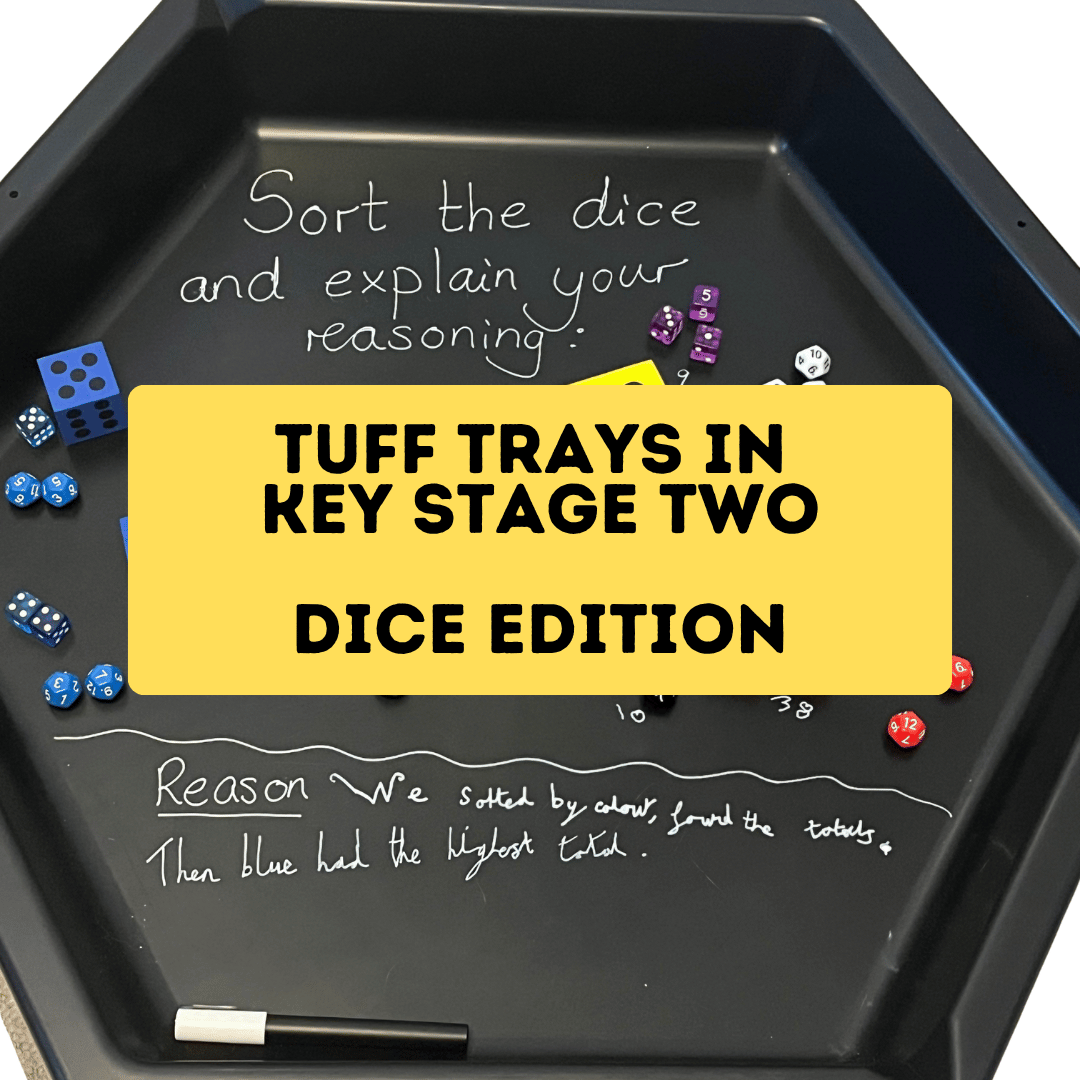
Dice are one of my favourite resources to use for play-based learning as you can do so many activities with them. Add a tuff tray and you can have children working together to apply, revise and consolidate their maths skills in a collaborative way.
Here are some ideas of how you can use some dice and a tuff tray in the classroom:
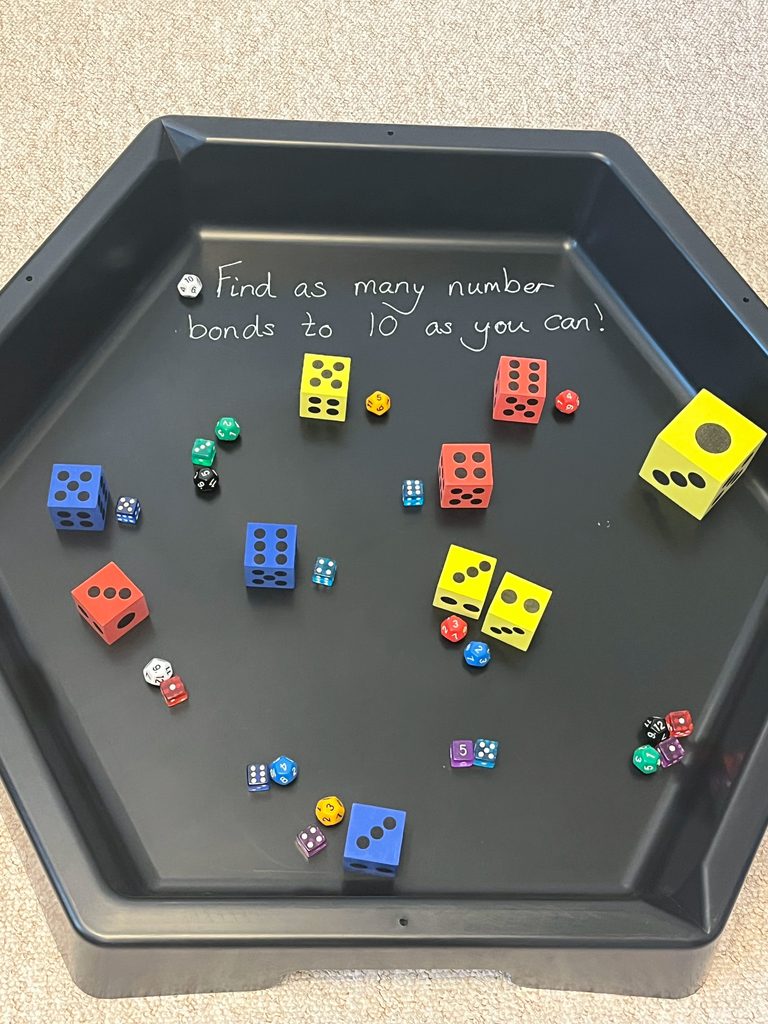
Children in Key Stage Two need a good understanding of number bonds to help them with more advanced addition calculations, scaling to larger multiples, inverse operations for subtraction and for estimating and checking answers. They are the building blocks for mental maths fluency and complex problem solving so don’t underestimate the power of recalling and rehearsing them on a regular basis to keep them fresh.
This activity is simple, roll the dice and work together to find as many number bonds to 10 as you can. The number bonds don’t just have to be created with 2 dice, you can use more dice added together, as long as they make 10.
Perhaps each group could have a competition to see how many number bond pairs or groups they created, collect the scores and turn them into a graph to show the data for each group.
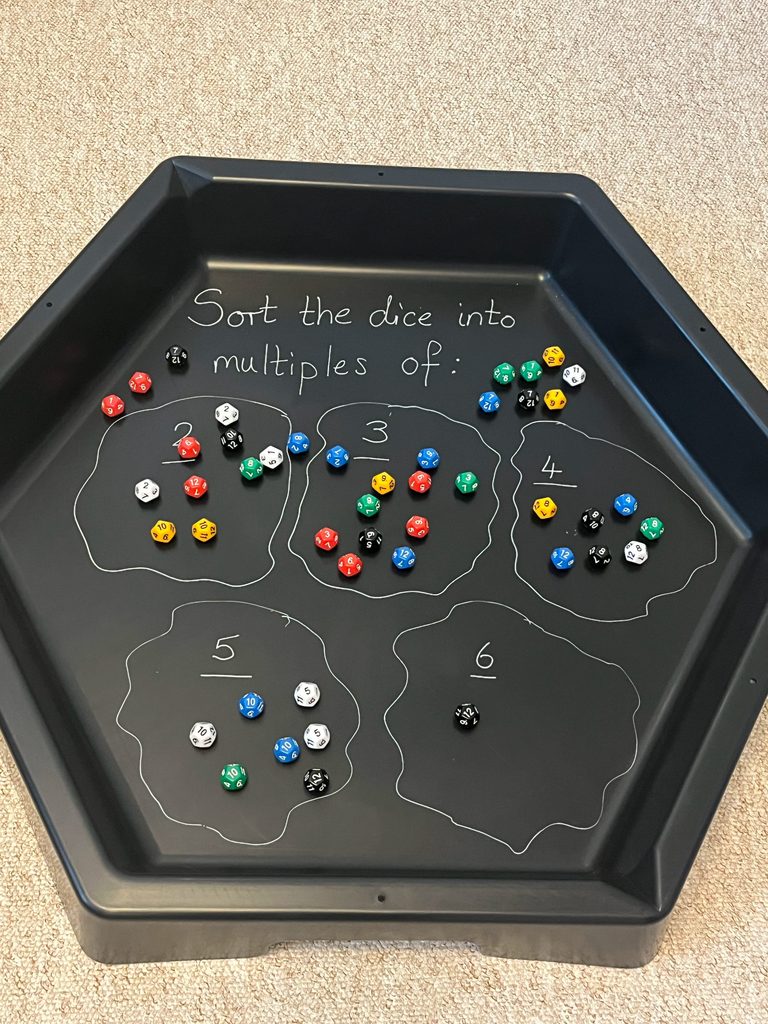
This activity lends itself to great group discussion. Some numbers fit into more than one multiple so where do we put them? Could we use a better method of sorting? Why do some numbers have more than one multiple? Why don’t some numbers fit into any of the spaces? Do they have a special name?
I would put some post-it notes by the side of the tuff tray so that groups could write down what they noticed and what questions they had. Perhaps the next groups that visits the tuff tray could try to answer them.
Use 12 sided dice to give a greater range of numbers for this activity.
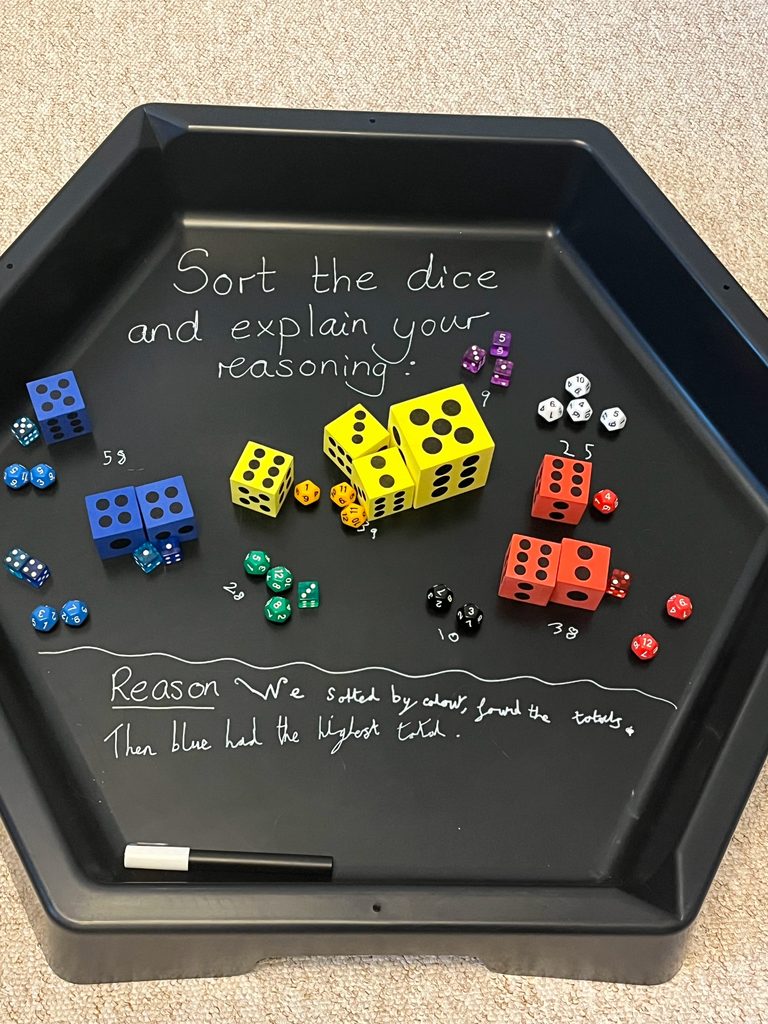
This sounds really simple but what a great challenge it would be to get each group to think of a different way to sort the dice. Sure you might get some sorting by colour or number but then encourage them to think of what we can do once we’ve sorted them, like in this example where we then added the total of each group of dice to see which colours scored the highest and lowest.
With this free play element there are no rules so as long as children can explain why they sorted them in the way that they did, they can do whatever they like.
Use a range of dice with different numbers of sides and you could also include some blank dice where you have written different numbers on the faces.
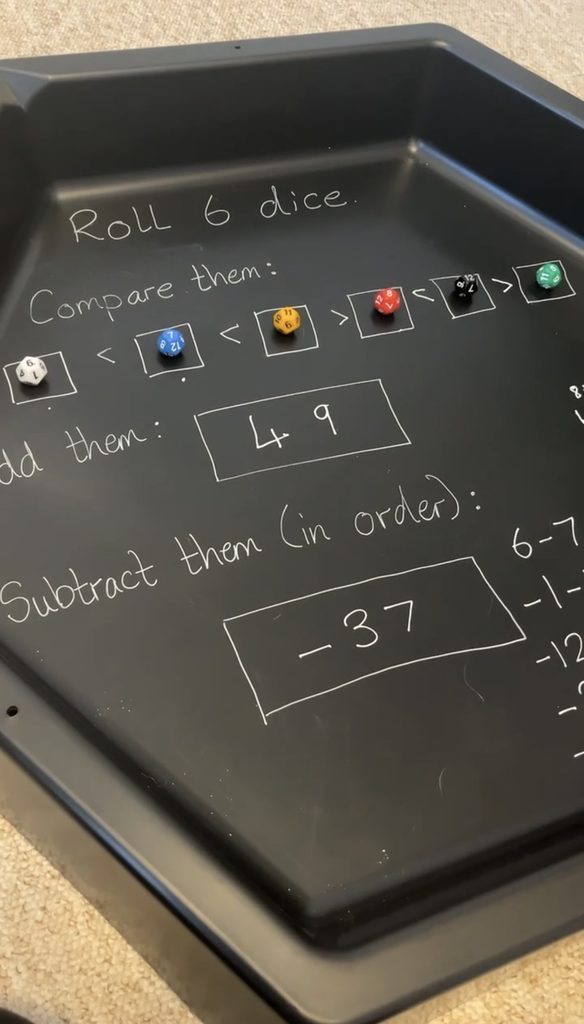
This activity really works on mental addition and subtraction skills but working as a group means that the children can share the different methods that they would each use, see in real-time which one was most efficient and which one was the most accurate.
My subtracting the dice rolls in order, children will also be able to work on subtracting with negative numbers.
Encourage the children to use the chalk pen to show their working and any mistake they make.
You could again turn it into a class competition to see which group got the biggest total when adding the dice numbers or compare their subtraction answers and order them from smallest to largest. There are so many ways to bring this back together as a class to discuss the learning that took place and continue it.
So there you have it. Just a selection of dice and a tuff tray and so many mathematical thinking and learning opportunities!
If you want more ideas like this for how to use a tuff tray for both English and maths learning in your classroom then take a look at my ‘Playful Tuff Tray Ideas Pack’ which includes an easy to setup activity for each week of the academic year.
Thanks to TTS Resources for gifting me one of their mini tuff trays which would be a great size in a Key Stage Two classroom with limited space and can easily fit 4-6 children around it. Take a look at the tuff tray and stand here.
Also thanks to TTS resources for gifting me the great selection of dice which you can find here.