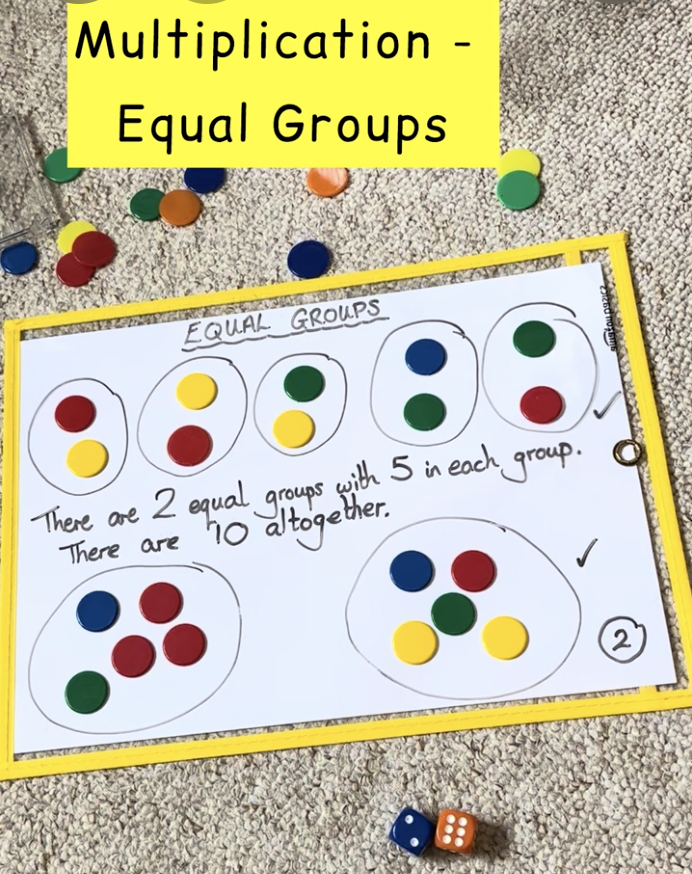
To help children understand multiplication by recognising and making equal groups , and to develop confidence in writing multiplication sentences.
Year 3 Multiplication and Division – Write and calculate mathematical statements for multiplication and division using the multiplication tables that they know, including for two-digit numbers times one-digit numbers, using mental and progressing to formal written methods.
Version 1: Using Dice to Create Groups
Roll each dice once to see how many groups you need and how many counters go into each group .
Build the groups using counters (e.g. 6 groups of 2 ).
Write a multiplication sentence in words to match (e.g. There are 6 equal groups with 2 in each group).
Flip the dice around to show commutativity (e.g. 2 groups of 6 ).
Write the new multiplication sentence (e.g. There are 2 equal groups with 6 in each group ).
Add up the total number of counters to check your answer. Version 2: Starting with the Total
Give children a set number of counters (e.g., 10 counters ).
Ask them to find as many ways as possible to make equal groups.Example: 5 groups of 2 and 2 groups of 5 .
Write down all the matching multiplication sentences.
Discuss why sentences are different but give the same product .
VIDEO
Builds a concrete understanding of multiplication as repeated addition .
Reinforces the idea of equal groups as the foundation of multiplication.
Develops use of correct mathematical vocabulary (“groups of…”, “in each group”).
Strengthens understanding of commutativity in multiplication (e.g., 6 × 2 = 2 × 6).
Encourages children to represent multiplication in different ways (using objects, arrays, and sentences).
Supports reasoning skills by exploring different groupings of the same total .
Links directly to the Year 2–3 multiplication objectives in the National Curriculum.