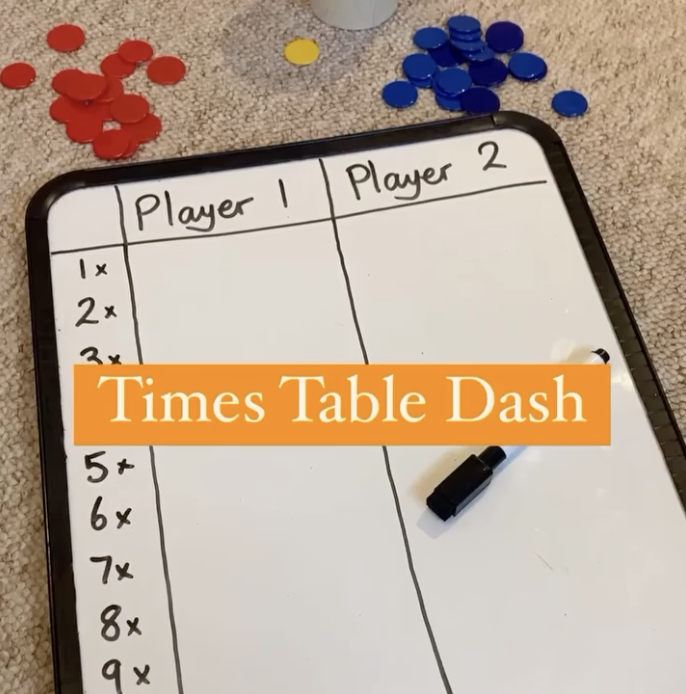
To practise times tables by racing to correctly write as many multiples of a chosen times table as possible.
What You Need
Counters in three different colours, for example:
Red counters
Blue counters
One special counter in a different colour, such as yellow
A pot, bag, or container to mix the counters in
A grid or list space on a whiteboard or piece of paper
A pen or whiteboard marker
A rubber
2 or more players
How to Play
Choose a Times Table Decide which times table you are going to practise (for example, the 4 times table).
Prepare the Counters Put all the counters into a pot or bag and mix them well so players cannot see which colours they are picking.
Take Counters On their turn, a player closes their eyes or looks away and randomly picks five counters from the pot.
Reveal the Counters Spread the counters out and count how many of each colour you have picked.
Write Multiples
Each red counter allows the player to write one multiple of the chosen times table in order.
For example, if practising the 4 times table: 4, 8, 12, 16, 20, and so on.
Remove Multiples
Each blue counter means the player must erase one multiple they have already written.
Watch Out for the Special Counter
If a player picks the special counter (for example, yellow), they must erase all the multiples they have written and start again from the beginning.
Take Turns Players take turns drawing counters and adding or removing multiples from their list.
Win the Game The game ends when a player successfully writes all 12 multiples of the chosen times table (for example, up to 48 for the 4 times table). Alternatively, if you decide to stop earlier, the player who has written the most correct multiples wins.
Educational Benefits
Builds fluency and confidence with times tables
Encourages mental maths practice
Develops number sequencing skills
Promotes strategic thinking and resilience
Makes practising maths interactive and engaging through gameplay