Times Tables! We all know how important they are to know but why are they so important, which times tables are children expected to know at different ages and how can we help our children to learn them?
Basically, having a good understanding of times tables helps your child feel more confident and helps them with loads of other things in maths such as division, fractions, word problems, long multiplication and more. They’re also pretty important for everyday life and are one of the things that you learn at school that you probably use quite a bit as a grown up in the real world too! If children are confident in their times tables, they often have the ability to problem solve more efficiently and confidently and solve mental maths problems more easily.
Children need to understand what actually happens when we multiply two numbers together so make it practical. School have lots of resources they can use for this but at home I always find snacks a winner! For instance for children to understand what 2 x 3 is, they need to understand that the x symbol means lots of so we are asking what is 2 lots of 3. With snacks, children can make 2 groups of 3 things and then total them together to make 6. If children can grasp what happens when we multiply, they will be able to visualise it more clearly in their head.
I am a firm believer that this is the best way for children to learn their times tables. Just a 10 minute game each day can really help children become more confident in them and you’ll see a huge improvement in no time. I have loads of free game ideas on my website here and a range of printable games available here. If you want over 30 game ideas for at home, school and while you’re out and about then my ‘Playful Times Table Game Ideas Pack’ is for you. Great for older children to be able to pick a game they want to play and easy enough to set it up for themselves and most of the games require very little set up too!
‘Find My Legs’ is such a popular game with the children I work with and I always get asked to play it. I have seen first hand the benefits of playing this game regularly with the same times table as they are enjoying playing the game rather than fearing getting an answer wrong.
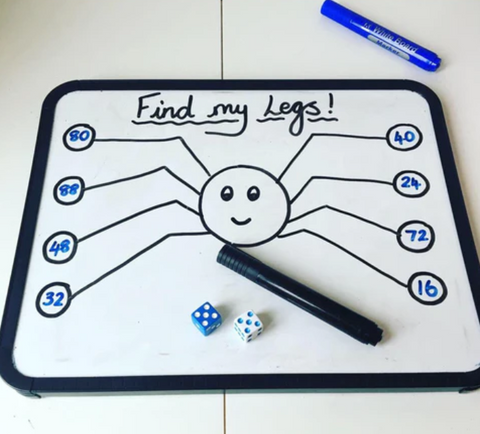
Start off by supporting children with the games you play by having the times tables, questions and answers visible to them. I always write the question and answer as this helps children to remember that 8 lots of 3 is 24 rather than always having to start from 1×3 and count on.
I often use some times table flashcards or just write them down on a piece of paper so they’re easy to see. As children become more confident in certain multiples of a times table you can cover them up with a post-it note until they feel confident enough not to look at all.

I really feel children should know why the maths they are learning is important and why it will help them in the ‘real world’. Model how knowledge of times tables can make life easier for them, for example, if you’re having 6 people round for dinner and each person needs 4 profiteroles, how can we use times tables to calculate how many profiteroles we need altogether? Showing children why they are relevant and important gives them more of a purpose.
Above all, try to use their interests to encourage and support them with their times tables. If your child like to sing then use songs to help them, if they enjoy being on the computer there are so many games out there to play, spend some quality time together by playing a physical game together or use what they love to make learning times tables fun and relevant to them. All children, just like adults, have different preferred styles of learning so work with your child to find out how they enjoy learning best and use that to help them with their tables.
Finally, even after this some children still struggle, as an adult I still have strikes of fear running through me if I get asked a question from the 12 times table! However, encourage children to use what they have on them and around them to help. It is not cheating to use your fingers, it is not cheating to keep adding 3 if you need to find the answer to a question in the 3 times table and it is not cheating to write them down on a piece of paper if they’re not sure. Make it relevant, make it easy and above all, make it fun!