Fractions! Some people love them, some people hate them, but they play a key part in maths learning in each year group and are one of those things in maths that are actually quite useful for everyday life.
In this blog I’m going to cover:
Children will have begun to explore equivalent fractions in Year 3 but will need lots more practical work to help them understand what they are and how to find them. Equivalent fractions are fractions which look different but are worth the same amount, e.g. 1/2 and 2/4. Fraction walls are often used in schools to help children see which fractions are equivalent. There is a good interactive version here for children to explore.
I’ve also got a hands on game that can be played using paper plates.
2. Count Up and Down in Hundredths and write tenths and hundredths as decimal numbers
Children will have explored tenths in Year 3 and will now move onto recognising hundredths. They will need to know how to count up and down in hundredths and also to recognise hundredths as decimal numbers, e.g. 1/100 = 0.01
So what questions are useful to ask your children?
I have made a game called ‘Fraction Count and Match’ which will help children practise counting in tenths and hundredths and finding their decimal equivalent. This is currently available as a free digital download. A place value grid would be a great addition to this game to help children see how their fraction can be converted to a decimal.
For this area of fractions, children will need to be able to answer questions such as, what is 1/4 of 20 or 2/5 of 35.
This needs to be done as practically as possible for children to understand what finding a fraction of amount is all about. My go to resource is Playdoh and I’ve put together a ‘how to’ activity here.
I also share a little rhyme with children to help them remember which is,
Divide by the bottom, times by the top.
This rhyme goes hand in hand with the practical activity so children understands what it means but I’ve always found it useful to help children remember what to do when they don’t have access to practical resources.
‘Fraction Finder’ is a good game to play, once children have got to grips with how to find fractions of amounts.
I’ve also got a digital download available to buy called ‘Calculate and Find’ which would work well with the activities above. Click here to download the game cards.
This is a lot easier than it looks and sounds, especially when you are adding and subtracting fractions with the same denominator. All you do is add or subtract the numerators (top numbers):
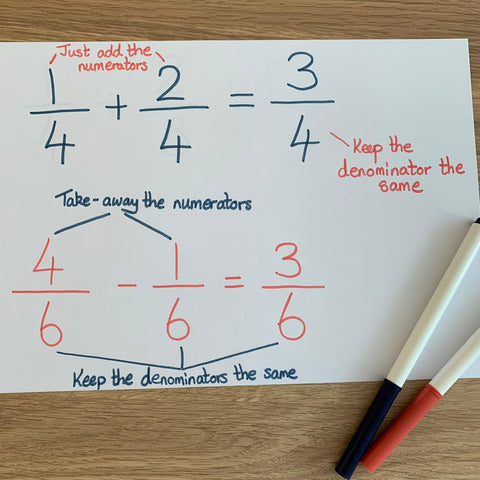
As always, it’s even more fun to practise this skill by playing a game and ‘Fraction Run’ or ‘Fill the Pancake’ are just the games for this!
5. Know the decimal equivalents to 1/4, 1/2, 3/4:
Knowing the decimal equivalents to certain fractions is just one of those things in maths that is a fact that children just need to know.
It’s important for children to understand why 1/4 = 0.25 and 1/2 = 0.5 and 3/4 = 0.75 though and the ‘Maths Is Fun’ website shows many different ways to explain how we can convert a fraction to a decimal so I’d recommend having a read of that if you want to explain it to your children.
‘Build the Roof’ is a lovely game to play if you have some building blocks around to play with. You don’t have to include the percentage equivalent too but you might want to add it and discuss that as well. Children in Year 4 do not need to know percentage equivalence though.
6. Solve Fraction Problems:
For each topic in maths, children are expected to use their knowledge of what they have learnt to solve problems. Reasoning is also a key part of maths learning which involves children talking about the maths and how they got their answer/explaining how something works. Some good question prompts for reasoning that you could use at home are:
For a card game to revise some of the key things about fractions (numerator, denominator, equivalents and adding/subtracting) just click here, download and play. Make sure you select the correct year group for your child as I have tailored the questions to suit what they will learn at school.
The best thing you can do at home is talk about the maths as you’re playing using some of the questions above. Talking about it, playing games and using hands-on activities will enable children to have a good understanding of fractions and will then make them more confident to answer problems about them.