You want to bring more play-based learning into your Key Stage 2 classroom but you are not sure where to begin. Perhaps you imagine expensive specialist resources, complicated planning or a classroom that becomes difficult to manage.The good news is that playful learning does not require hundreds of new resources. You can start with ordinary items already found in most classrooms and use them in more engaging ways. A dice can become a decision-maker, a pack of cards can generate a maths challenge and a Post-it note can turn a question into a treasure hunt. This blog explores six simple resources that make learning more active, collaborative and memorable – and shows how to make them part of everyday classroom life.
Play-based learning is not about replacing purposeful teaching with unstructured games. It is about changing the experience of learning so children have more opportunities to explore, make decisions, test ideas and work with others. A worksheet or textbook page might ask children to complete a set of questions however, a playful version could involve rolling dice to generate calculations, using cards to create a challenge or moving around the room to find information. The learning objective remains important, the difference is that children interact with the content in a way that feels more active and engaging. This change in experience can also affect attitudes and behaviour. When children are faced with a worksheet, they may immediately associate the task with routine written work. When the same learning is presented as a game, the atmosphere can change. Motivation increases, children become more involved and the dynamics of the lesson often improve.
Playful learning supports:
You do not need to buy everything at once and what I suggest you need, you probable already have in your classroom anyway.
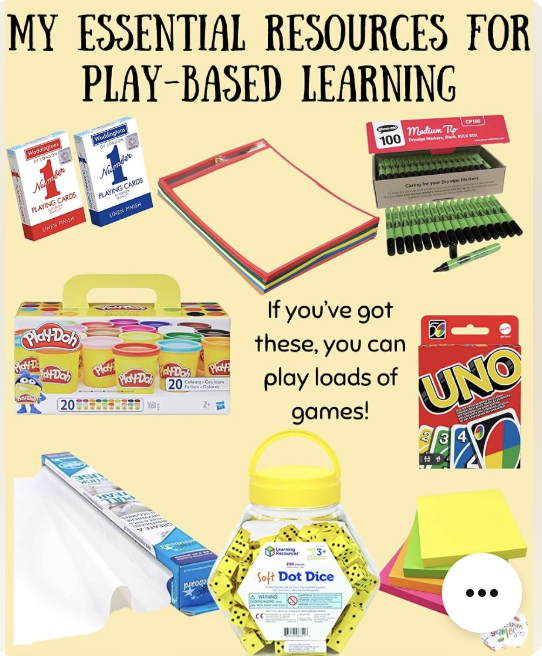
Each resource can be used across subjects, which makes it a practical investment for a busy classroom. See my Amazon store here to buy my top favourite resources.
Dice are one of the most versatile resources for playful learning. You can use standard six-sided dice, 12-sided dice, blank dice and/or foam dice, depending on the activity and the age of your pupils. Adding a dice immediately gives children something physical to interact with. If every child or pair has a dice, everyone is involved at the same time, no one is waiting for a volunteer to answer a question from the board.
Dice can support learning in areas such as:
For example, children might roll two dice and:
For dice games and free printables so you can play straight away, head to this page on my website.
Blank dice make the resource even more adaptable. You can write numbers, symbols, vocabulary or instructions on them using whiteboard pens. Dice also support differentiation without requiring completely different resources for each group. Every pupil can use a dice, while the task changes according to their needs. One group might practise addition, while another uses the same dice to build multi-step calculations. Foam dice are particularly useful for reducing classroom noise (my top tip that I discovered too late in my teaching career)!
UNO cards are a teacher’s secret weapon because they are familiar, colourful and easy to use. Children often recognise the cards immediately, which creates interest before the activity has even begun. The numbered cards can generate instant calculations and questions. Instead of printing number cards or relying on a worksheet, pupils can draw cards and create their own examples.
UNO cards are useful for:
Watch this video to see one way I use Uno cards for place value learning. It also includes a free printable too which you can find here.
The special Uno cards can also add extra layers to a game:
Because UNO cards are portable and inexpensive, you can use them around in the classroom, hall or playground. One pack can be divided between several groups, making it a cost-effective resource. For more Uno games, click here.
Post-it notes are particularly useful when you want children to move around the classroom or make their thinking visible. You can use them for:
For a treasure hunt, place questions or pieces of information around the room. Children move around to find the answers or identify the most relevant details. During a gallery walk, groups can visit different displays and add their ideas to Post-it notes. They might record a question, make a connection or identify the most important information. Post-it notes are also a quick assessment tool. At the end of a lesson, ask each child to answer a question or explain one thing they have learnt, they can add their name and place the note on a board as they leave. You then have an immediate visual overview of the class. Responses can be grouped into categories such as:
This can be more manageable than collecting a pile of books and trying to assess every response later. It also keeps the assessment low pressure. Children are more likely to contribute when the task feels brief and informal. I am currently in love with large Post-it notes (I get mine from Sainsburys). They are so useful for teacher demonstrations, group planning and collaborative displays.
For more ways to play with post-it notes, click here.
Play dough is often associated with early years classrooms, but it can be highly effective in Key Stage 2. When children’s hands are engaged, they become more focused on the learning. Play dough offers a physical way to explore ideas, model concepts and create representations. It can be used for:
Play dough also supports fine motor skills. Rolling, pulling, twisting and separating the material all involve controlled hand movements, even when the main lesson objective is maths, science or English. Another benefit is that it can reduce distractions. Instead of tapping a pencil, fiddling with an eraser or looking for something else to do, children have a purposeful object to handle. Most importantly, play dough encourages creativity and independent thinking. Children can explore an idea without worrying about producing a perfect answer immediately. They can change their model, discuss possibilities and learn through trial and error.
Wipeable sleeves allow you to turn printed activities, paper or game boards into reusable resources. Children can write on the sleeve with a whiteboard pen, then wipe it clean when they have finished.
They are useful for:
A simple piece of paper inside the sleeve can become an individual whiteboard. You can also place a printable game or activity inside and use it repeatedly with different groups. This reduces photocopying and preparation. More importantly, it changes how children feel about mistakes. When work is written in an exercise book, pupils may worry about crossing something out or getting an answer wrong. A wipeable sleeve makes the learning feel temporary. They can test a method, erase it and try again. That low-risk environment encourages:
For play-based learning to work well, children need to feel safe exploring ideas. Wipeable sleeves help create that culture without reducing the level of challenge.
A standard pack of playing cards offers a large number of possibilities without requiring any printing, cutting or laminating. You can use the numbers, suits, colours and patterns in different ways. For example, children might use red and black cards to represent positive and negative numbers, or sort cards into odd and even numbers.
Playing cards can support:
They are also useful for social learning. Most card games involve turn-taking, cooperation, negotiation and healthy competition. Because the cards are familiar, setup is quick. You do need a system for collecting them at the end of the lesson, but they are generally easier to manage than a collection of handmade number cards in separate envelopes. Playing cards are not limited to maths. With a little adaptation, they can be used in English, science, history and other foundation subjects. Suits might represent categories, colours might indicate difficulty and numbers might determine how many examples a child needs to provide.
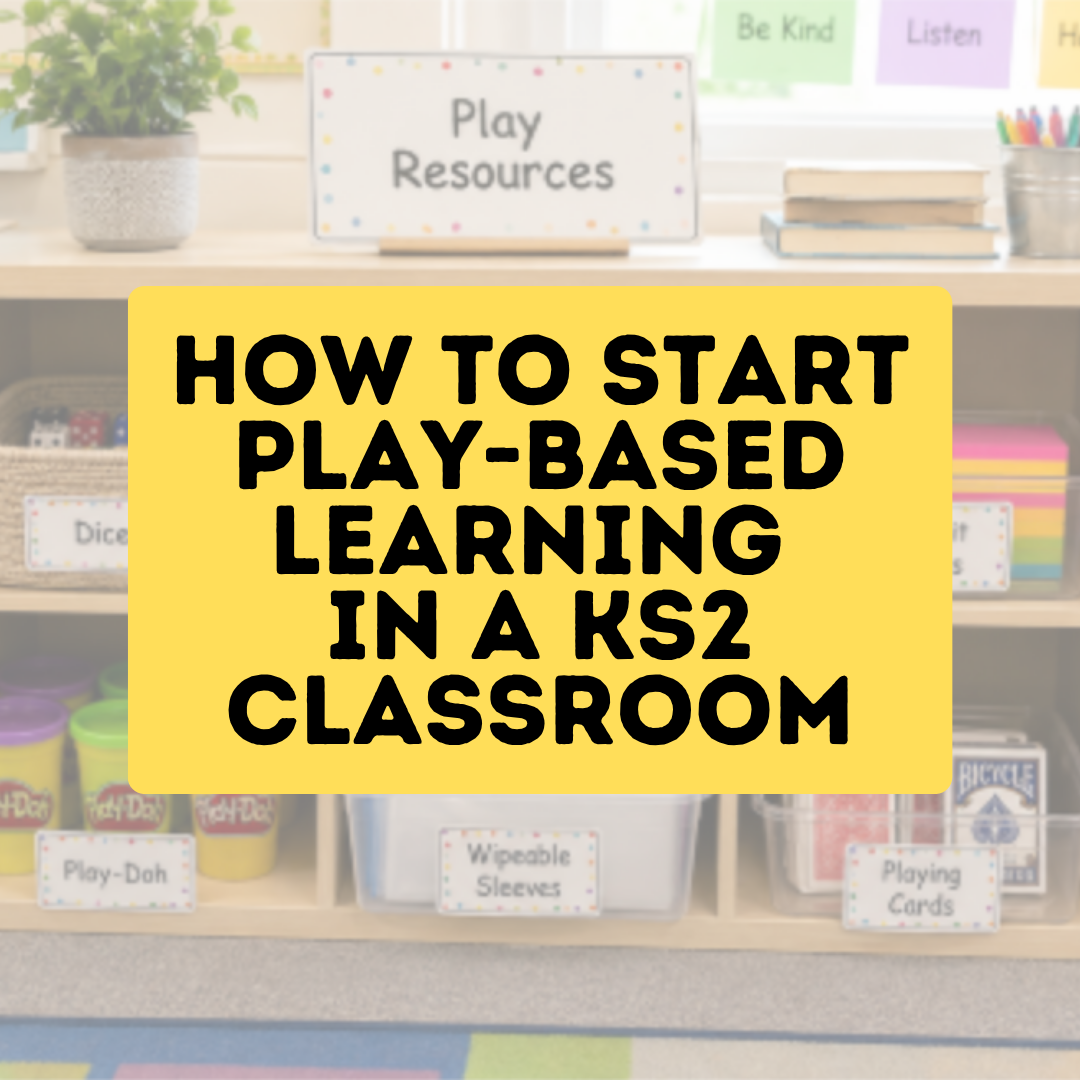
Having the resources is only the first step. If they are hidden in a cupboard or stored in difficult-to-open boxes, you are less likely to use them regularly. The aim is to make playful learning resources visible, accessible and part of normal classroom routines. You could create:
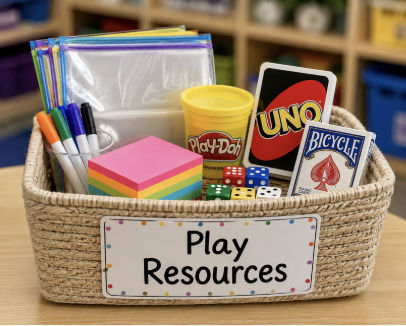
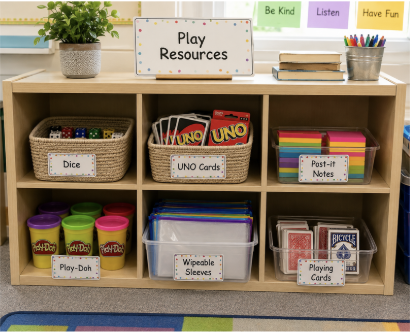
If you cannot provide a set for every table, use one clearly labelled area in the classroom. Open baskets and clear trays work better than closed containers because children can see what is available. Labels are important too. If you ask a pupil to collect the UNO cards or dice, they should know exactly where to go and what to take. Accessible resources help children become more independent. They also reduce transition time. Instead of spending ten minutes distributing equipment, pupils can collect what they need and begin the task more quickly. The larger goal is to make play resources as ordinary as exercise books. If children see them as part of everyday learning, playful activities become easier to embed across the curriculum.
You do not need to redesign your entire classroom or turn every lesson into a large-scale game. Start with small changes. Transform an existing task. Take a worksheet or textbook activity and ask:
And you don’t have to think of these ideas yourself. I have done all the work for you and you can find game ideas and printable resources for hundreds of maths and English objectives on my website. You can also search by objective on my website too and find a game or games suited to it. Click below to take a look:
This approach keeps the learning objective intact while changing the way children interact with it. Start with one resource and use it regularly. Dice are a good starting point because they work especially well in maths, but Post-it notes or playing cards can be just as effective. A simple first activity might involve giving each pair a dice and asking them to create a calculation using the number rolled. Once the routine is familiar, introduce further rules or levels of challenge. Keep the rules clear. Playful learning works best when children understand both the learning goal and the game rules. Explain:
The activity can be fun without becoming chaotic. Clear routines around collecting, using and returning resources are essential. The activity should give you opportunities to listen, observe and assess. Move around the room and notice who is explaining their thinking, who is making progress and who needs support. Play-based learning is not separate from assessment. In many cases, it makes children’s thinking more visible because they are talking, making choices and explaining their strategies.
Yes. Play-based learning is not only for younger children. Key Stage 2 pupils can use games, challenges and hands-on resources to develop reasoning, collaboration, creativity and subject knowledge.
No. Dice, playing cards, UNO cards, Post-it notes, play dough and wipeable sleeves are inexpensive and often already available in classrooms. The main change is how you adapt familiar resources for purposeful learning.
Use clear routines, short instructions and defined expectations for movement and voice levels. Foam dice can reduce noise, while table baskets and labelled resource areas can make transitions quicker and calmer.
Observe children as they work, listen to their explanations and use quick tools such as Post-it-note exit tickets. Wipeable sleeves can also support self-correction and allow you to see children’s working during the activity.
Yes. Cards, dice, Post-it notes, play dough and wipeable sleeves can be adapted for English, science, history, geography and other subjects. Use colours, numbers, symbols or suits to represent different categories or challenges.
Creating a playful Key Stage 2 classroom does not begin with buying a large collection of specialist equipment. It begins with looking differently at the resources you already have. Dice can make every child an active participant. UNO and playing cards can generate instant challenges. Post-it notes can turn assessment and information gathering into movement-based activities. Play dough can support creativity and concentration, while wipeable sleeves make mistakes easier to manage. Choose one resource, adapt one familiar task and make the equipment easy for children to access. Over time, these small changes can make playful learning a natural part of everyday classroom life. Want more ideas for playful learning? Just click here and you’ll find ready made ideas and resources to help you and your children learn through play!